Introduction简介
I am a final-year undergraduate in the School of Software Engineering at South China University of Technology. My work sits between LLM agents and natural language processing.
Broadly, I am interested in what it takes for a language model to be reliable rather than merely fluent. A confident, well-formed answer is easy to obtain; a system whose intermediate reasoning is actually grounded in evidence — and that knows when it should decline to commit — is much harder. I find the second kind far more interesting, and I think the gap between them is where most of the remaining work is.
I care about the price of that reliability too. A lot of recent work buys accuracy by adding agents, rounds of debate, or longer chains of thought, and reports the gain without reporting the bill. I would rather the computation a system spends scale with how hard the instance actually is: cheap paths for easy inputs, and deliberation reserved for genuine disagreement. Efficiency, on this view, is not a separate engineering concern bolted on at the end — it is part of what makes a design defensible.
These questions show up sharply in structured prediction, which is where most of my work has been so far: the output has to be correct in form as well as in content, so vague reasoning has nowhere to hide.
- LLM agents — multi-agent coordination, debate and self-verification, planning and tool use
- Large language models — reasoning under uncertainty, calibration, inference-time methods
- NLP — information extraction, zero-shot and low-resource transfer, robust evaluation
I am looking for Ph.D. / M.Phil. positions in NLP and agentic systems, and I am always glad to talk about any of the above — feel free to get in touch.
我是华南理工大学软件学院 软件工程专业大四本科生(2023 级),研究方向介于 大模型智能体 与 自然语言处理 之间。
我关心的核心问题是:要让语言模型可靠而不只是流畅,究竟需要什么。让模型给出一个自信、 格式规整的答案并不难;难的是让它的中间推理真正有证据支撑,并且在证据不足时知道“不下结论”。 后者要有意思得多,我也认为剩下的大部分工作都在这两者之间的差距里。
我同样在意可靠性的代价。近来不少工作通过增加智能体数量、辩论轮数或更长的思维链来换取准确率, 却只报告收益、不报告开销。我更希望系统投入的计算量与问题本身的难度相匹配 —— 简单输入走低成本路径,只有在出现真正的分歧时才展开深入推敲。 在这个视角下,效率并不是最后才补上的工程细节,而是一个设计是否站得住脚的一部分。
这些问题在结构化预测任务中体现得尤其明显,这也是我目前工作的主要场景: 输出不仅内容要正确、形式也必须正确,含糊的推理无处遁形。
- 大模型智能体 —— 多智能体协作、辩论与自我校验、规划与工具调用
- 大语言模型 —— 不确定性下的推理、置信度校准、推理期方法
- 自然语言处理 —— 信息抽取、零样本与低资源迁移、稳健评测
目前在寻找 NLP 与智能体方向的 博士 / 研究型硕士 机会, 也随时欢迎就以上话题交流,请随时联系我。
Education & Experience学历 / 工作
-
2023.09 – 2027.06
 South China University of Technology华南理工大学
School of Software Engineering
软件学院 · 软件工程
Guangzhou · B.Eng. (expected)
广东广州 · 本科(预计)
Publications论文
-
Kenfeng Huang, Yi Cai, Xin Wu, Zikun Deng, Li Yuan. “SMADE-IE: Sparse Multi-Agent Framework with Evidence-Driven Debate for Zero-Shot Information Extraction.” Proceedings of the 2026 Conference on Empirical Methods in Natural Language Processing (EMNLP 2026), Main Conference. EMNLP 2026 主会(Conference on Empirical Methods in Natural Language Processing)。 CCF B [arXiv]
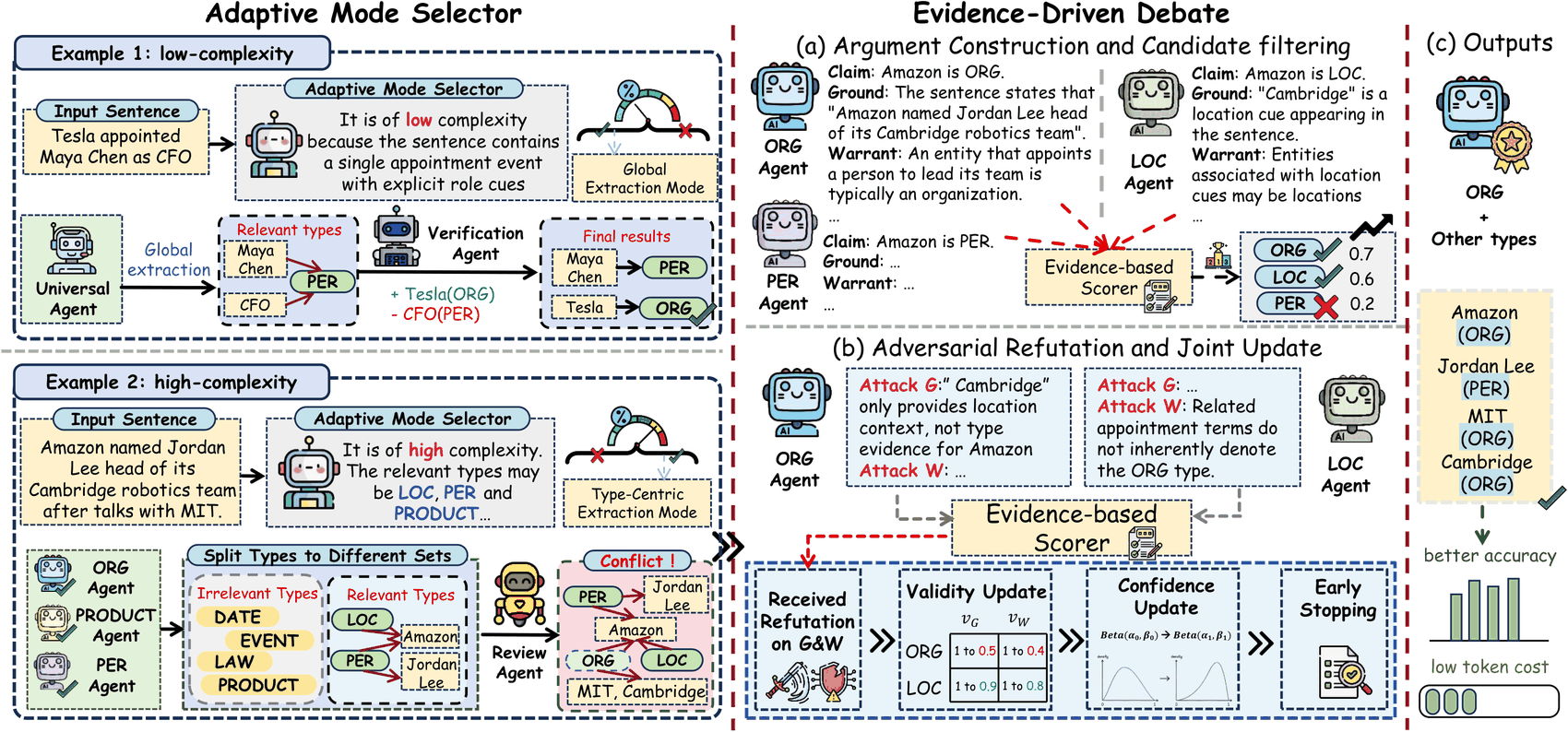
An Adaptive Mode Selector routes each input to global or type-centric extraction; conflicting predictions are then settled by Toulmin-structured, evidence-driven debate with Bayesian confidence aggregation. 自适应模式选择器将输入路由至全局抽取或类型中心抽取; 对冲突预测再通过 Toulmin 结构化的证据驱动辩论与贝叶斯置信度聚合加以裁决。
News近况
- 2026.08 SMADE-IE is accepted to the EMNLP 2026 Main Conference. SMADE-IE 被 EMNLP 2026 主会接收。
- 2026.06 Preprint on arXiv: 2606.04691. 预印本上线 arXiv: 2606.04691。
- 2023.09 Started my B.Eng. at South China University of Technology. 进入华南理工大学软件学院就读。
Contact联系
- Personal 个人 kenfenghuang@gmail.com
- University 校内 202330370891@mail.scut.edu.cn